
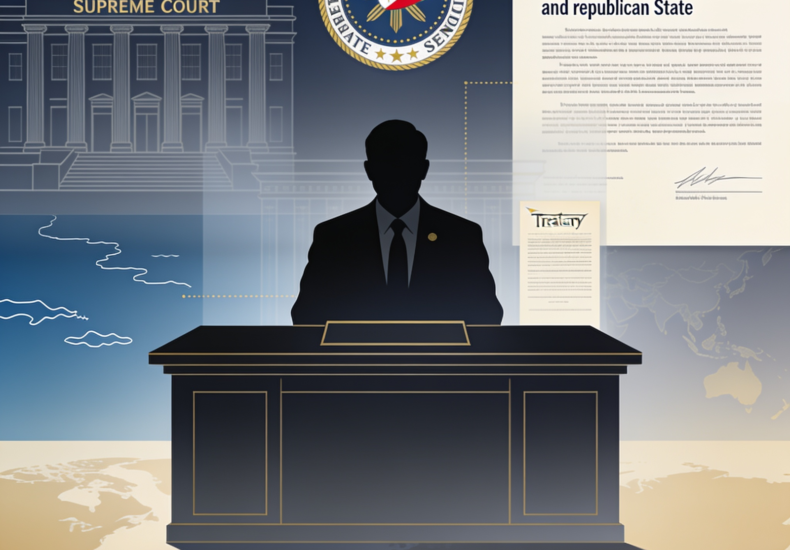
Executive Dominance and Institutional Constraints in Philippine Foreign Policy


Executive Dominance and Institutional Constraints in Philippine Foreign Policy
Analytical Studies & Perspectives of Roldan G. Gorgonio
Sovereignty is the bedrock of the modern state. It represents an insular autonomy, a shield against external encroachment, and the exclusive right to make binding, authoritative choices (Krasner, 2001; Woodley, 2015).
Under the classical Westphalian framework or state‑centric sovereignty model, states exist as equal, independent legal units that reject unauthorized external interference within their domestic jurisdictions (Grimm, 2016; Coe, 2019).
This external sovereignty demands that a state speak with a single, unified voice in global affairs (Stilz, 2019). When outside entities usurp this voice or dictate national policy, domestic constitutional integrity is functionally compromised (Hooker, 2009).
Consequently, the codification of an independent foreign policy is not merely a symbolic declaration. It is an active legal mechanism designed to protect the state’s political autonomy and general will (Bartelson, 1995; Villacorta, 1989).
How Constitutional Design Shapes Philippine Foreign Policy Autonomy
The constitutional architecture of the Republic of the Philippines codifies this protective shield with explicit legal force. Under Article II, Section 7 of the 1987 Philippine Constitution, the state is mandated to pursue an independent foreign policy driven by national sovereignty, territorial integrity, national interest, and the right to self-determination (Republic of the Philippines, 1986). This legal imperative is reinforced by companion clauses. Article II, Section 8 establishes a nuclear-weapon-free territory, while Article XVIII, Section 25 bans foreign military bases, troops, or facilities unless sanctioned by a Senate-concurred treaty (Republic of the Philippines, 1986).
This rigid constitutional schema contrasts sharply with the American system. In the United States, foreign affairs powers are divided between the executive and legislative branches without an explicit constitutional directive forcing an “independent” policy free from foreign influence (Cornell Law School). Instead, the American system relies heavily on presidential hegemony. This is exemplified by the “sole organ” doctrine articulated in United States v. Curtiss-Wright Export Corp. (1936), which grants the executive plenary authority in international relations (Supreme Court of the United States, 1936). In the Philippines, however, foreign policy is a shared, tripartite responsibility (Philstar Global, 2021). The President acts as the chief architect of foreign relations but must navigate a strict separation of powers, sharing treaty-making authority with the Senate, which requires a two-thirds concurrence for international pacts to attain domestic validity (Resurreccion, 2016).
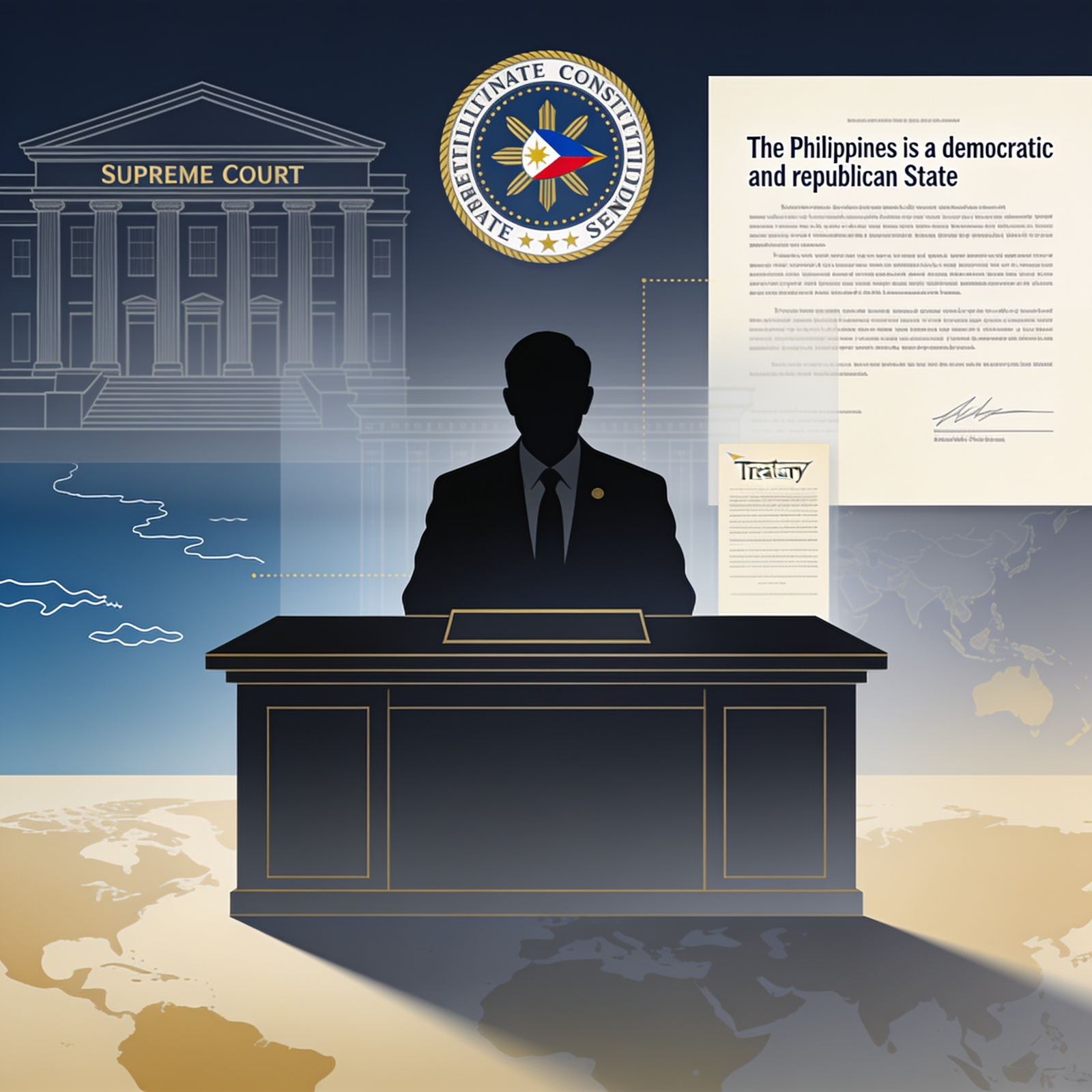
This constitutionalization serves as an innovative tool for systematic cleanup and programmatic governance. Historically, the mandate was born out of a critical necessity to dismantle decades of post-World War II dependency and asymmetrical vassalage to the United States. During the 1950s, Senator Claro M. Recto emerged as the primary intellectual force challenging the “special relations” between Manila and Washington (De Castro, 1989). Recto famously argued that U.S. military bases functioned as “magnets of aggression” rather than protective shields, criticizing sentimentalism in statecraft (De Castro, 1989). To institutionalize this critique, the framers of the 1987 Constitution sought to build permanent legal barriers against foreign dictation, protect the national patrimony, reject aid-motivated compliance, and assert strategic agency (Villacorta, 1989).
How Jurisprudence Shapes Alliance Policy
Asserting an independent foreign policy does not imply absolute isolationism. Entering into binding international agreements is a direct expression of sovereign power (Krasner, 2001). Rather than diminishing state authority, these pacts reflect a deliberate, self-determined choice to advance national interests through structured cooperation (Constitutional Principle of Pursuing an Independent Foreign Policy).
The Philippine judiciary has systematically optimized this principle, validating security alliances as necessary, programmatic tools for defensive deterrence. In Bayan v. Zamora (2000), the Supreme Court upheld the constitutionality of the Visiting Forces Agreement (VFA), ruling that joint military exercises did not violate sovereign parity as long as the agreement satisfied Senate concurrence and maintained reciprocal recognition (Supreme Court of the Philippines, 2000).
Legal actions of this nature demonstrate highly optimized strategic efficiency. By utilizing executive agreements, the state retains the flexibility to navigate global geopolitics while preserving its legal and physical sovereignty. This flexibility was affirmed in Bayan Muna v. Romulo (2011). In that case, the Supreme Court upheld a Non-Surrender Agreement with the United States, recognizing that the executive branch requires broad latitude to utilize diverse diplomatic instruments (Supreme Court of the Philippines, 2011).
Defense partnerships are active choices of sovereign self-preservation. In Saguisag v. Ochoa (2016), the Supreme Court evaluated the Enhanced Defense Cooperation Agreement (EDCA), which permitted U.S. forces access to local military facilities (Supreme Court of the Philippines, 2016). The Court ruled that building defensive deterrence through strategic partnerships is a valid exercise of sovereignty that aligns with the paramount considerations of national interest (Supreme Court of the Philippines, 2016). The law does not mandate weakness. Instead, it justifies the creation of alliances to prevent coercion by aggressive regional actors.
This legal logic is mirrored in comparative international jurisprudence. In Missouri v. Holland (1920), the United States Supreme Court established that valid treaty obligations override domestic state-level jurisdictions, reinforcing the idea that international engagements are supreme exercises of national authority (Supreme Court of the United States, 1920). Similarly, in the Philippines, the Supreme Court in Pangilinan v. Cayetano (2021) recognized that treaty alignments, such as the Rome Statute of the International Criminal Court, reflect valid legislative and executive choices to adopt global human rights standards, even as the court validated the President’s subsequent unilateral withdrawal as an exercise of executive discretion in foreign affairs (Philippine Supreme Court, 2021).
Navigating Ideology and Strategy on Foreign Policy Across Administrations
The practical execution of an independent foreign policy has shifted across successive administrations, reflecting a dynamic tension between populist rhetoric and institutional realism.
                 PHILIPPINE INDEPENDENT FOREIGN POLICY
              (Article II, Section 7, 1987 Constitution)
                                │
         ┌──────────────────────┴──────────────────────┐
         ▼                                             ▼
DUTERTE ADMINISTRATION                       MARCOS JR. ADMINISTRATION
     (2016–2022)                                    (2022–Present)
         │                                             │
• Decoupling from US hegemony                • "Friend to all, enemy to none" -(debatable)
• Populist "Pivot to China/Russia"           • Deeper defense integration with US
• High-stakes economic transactionalism      • Rules-based international law focus
• Criticized as shifting dependency          • Active sovereign rights defense (WPS)
During the administration of President Rodrigo Duterte (2016–2022), the rhetoric of independence was deployed as a political tool to decouple the nation from its historical alignment with the United States (Velasco, 2022). Duterte pursued a “pivot” toward Beijing and Moscow, emphasizing transactional economic benefits (Wong, 2019). However, analysts observed that this approach risked trading historic dependencies for new, unequal relationships, failing to arrest maritime expansionism in the West Philippine Sea (Velasco, 2022; Wong, 2019).
Under President Ferdinand Marcos Jr. (2022–Present), the execution of the constitutional mandate has been optimized through rules-based multilateralism. Adopting the posture of “a friend to all, enemy to none,” the current administration has revitalized traditional security architectures under the Mutual Defense Treaty (MDT) and EDCA (Rocamora, 2022). This posture is formalized in Executive Order No. 37, which directs the implementation of the National Security Policy 2023-2028 (Marcos, 2023). Under this policy, defending sovereign rights in the West Philippine Sea in accordance with international law is recognized as the highest form of national interest (Marcos, 2023).
Institutional Gaps in Philippine Foreign Policy
An explicit constitutional mandate provides structural defense mechanisms against “hegemonic international law” (Constitutional Principle of Pursuing an Independent Foreign Policy). Global governance institutions often lack independent enforcement powers, relying on individual states to implement international mandates (Grimm, 2016).
When international bodies attempt to impose a hierarchy of norms without democratic legitimacy, they threaten domestic political autonomy (Cohen, 2012). By enforcing constitutional protections—such as limits on foreign economic control and restrictions on foreign military presence—the state prevents the formation of patron-client relationships and preserves its internal “general will” (Constitutional Principle of Pursuing an Independent Foreign Policy,).
Despite these systemic advantages, a primary challenge remains. How can a middle power maintain long-term, non-partisan strategic consistency when its chief foreign policy architect changes every six years? The contrasting approaches of the Duterte and Marcos administrations highlight how a single constitutional text can be interpreted to justify diametrically opposed geopolitical paths.
Future academic inquiry must examine the institutional mechanisms required to insulate national security policies from shifting executive preferences. To ensure that an independent foreign policy remains an effective tool for national preservation, researchers should investigate how legislative and judicial oversight can be strengthened to maintain a stable, rule-of-law-oriented posture across administrative transitions.
————————————————————
REFERENCES
Asia Pacific Pathways to Progress Foundation Inc. (2021). Assessing the Duterte administration’s independent foreign policy. Asia Pacific Pathways to Progress. [https://pathways.org.ph](https://pathways.org.ph/?utm_source=copilot.com “pathways.org.ph”)
Aquino, C. C. (1987, February 27). Executive Order No. 132: Reorganizing the Department of Foreign Affairs. The LawPhil Project. `https://www.lawphil.net/executive/execord/eo1987/eo1321987.html` [(lawphil.net in Bing)](https://www.bing.com/search?q=%22https%3A%2F%2Fwww.lawphil.net%2Fexecutive%2Fexecord%2Feo1987%2Feo1321987.html%22&utm_source=copilot.com “www.bing.com”)
Aquino, C. C. (1987, July 24). Executive Order No. 239: Reorganizing the Department of Foreign Affairs and for other purposes. Supreme Court E‑Library. `https://elib.judiciary.gov.ph/thebookshelf/showdocs/2/11545` [(elib.judiciary.gov.ph in Bing)](https://www.bing.com/search?q=%22https%3A%2F%2Felib.judiciary.gov.ph%2Fthebookshelf%2Fshowdocs%2F2%2F11545%22&utm_source=copilot.com “www.bing.com”)
Bagong Alyansang Makabayan v. Zamora, G.R. No. 138570. (2000, October 10). Supreme Court of the Philippines. `https://lawphil.net/judjuris/juri2000/oct2000/gr1385702000.html` [(lawphil.net in Bing)](https://www.bing.com/search?q=%22https%3A%2F%2Flawphil.net%2Fjudjuris%2Fjuri2000%2Foct2000%2Fgr1385702000.html%22&utm_source=copilot.com “www.bing.com”)
Bartelson, J. (1995). A genealogy of sovereignty. Cambridge University Press. [https://doi.org/10.1017/CBO9780511586385](https://doi.org/10.1017/CBO9780511586385?utm_source=copilot.com “doi.org”)
Bayan Muna v. Romulo, G.R. No. 159618. (2011, February 1). Supreme Court of the Philippines. `https://lawphil.net/judjuris/juri2011/feb2011/gr1596182011.html` [(lawphil.net in Bing)](https://www.bing.com/search?q=%22https%3A%2F%2Flawphil.net%2Fjudjuris%2Fjuri2011%2Ffeb2011%2Fgr1596182011.html%22&utm_source=copilot.com “www.bing.com”)
Biersteker, T. J., & Weber, C. (1996). State sovereignty as social construct. Cambridge University Press.
Butterfield, H., & Wight, M. (1966). Diplomatic investigations: Essays on the theory of international politics. George Allen & Unwin.
Cabantac, M. (2020, January 15). Philippine foreign policy overview. Scribd. `https://www.scribd.com/document/456789/Philippine-Foreign-Policy-Overview` [(scribd.com in Bing)](https://www.bing.com/search?q=%22https%3A%2F%2Fwww.scribd.com%2Fdocument%2F456789%2FPhilippine-Foreign-Policy-Overview%22&utm_source=copilot.com “www.bing.com”)
Carpio, A. T. (2020, February 26). Implications of VFA termination on EDCA and MDT. Institute for Maritime and Ocean Affairs. [https://www.imoa.ph](https://www.imoa.ph/?utm_source=copilot.com “www.imoa.ph”)
Carpio, A. T. (2021, August 19). Above the law. Philippine Daily Inquirer. `https://opinion.inquirer.net/143254/above-the-law` [(opinion.inquirer.net in Bing)](https://www.bing.com/search?q=%22https%3A%2F%2Fopinion.inquirer.net%2F143254%2Fabove-the-law%22&utm_source=copilot.com “www.bing.com”)
Castro, E. T. (2019, May 12). Understanding Article II Section 7–24 of the 1987 Philippine Constitution. Scribd.
Coe, B. N. (2019). Sovereignty in the south: Intrusive regionalism in Africa, Latin America, and Southeast Asia. Routledge.
Cohen, J. L. (2012). Globalization and sovereignty: Rethinking legality, legitimacy, and constitutionalism. Cambridge University Press.
Congress of the Philippines. (1991, September 19). Republic Act No. 7157: An act to reorganize and strengthen the Philippine Foreign Service. LawPhil.
Cooper, B., Dyzenhaus, D., & Heller, H. (2019). Sovereignty: A contribution to the theory of public and international law. Oxford University Press.
Cornell Law School. (n.d.-a). Foreign affairs as a political question. Legal Information Institute.
Cornell Law School. (n.d.-b). Powers of the executive branch to regulate national security and foreign affairs. Legal Information Institute.
Council on Foreign Relations. (2017, March 2). U.S. foreign policy powers: Congress and the President.
De Castro, R. (1989). Historical review of the concept, issues, and proposals on an independent foreign policy for the Philippines: 1955–1988. Asian Studies.
De Castro, R. (1989, January 13). Historical review of the concept, issues and proposals on an independent foreign policy for the Philippines: 1955–1988. Asian Studies: Journal of Critical Perspectives on Asia, 27(1), 7–34.
Derian, J. D. (2009). Critical practices in international theory: Selected essays. Routledge. [https://doi.org/10.4324/9780203882634](https://doi.org/10.4324/9780203882634?utm_source=copilot.com “doi.org”)
Duterte, R. R. (2019, November 29). Executive Order No. 97: Reorganizing the Presidential Commission on Visiting Forces. LawPhil.
Eckersley, R. (2004). The green state: Rethinking democracy and sovereignty. MIT Press.
European Commission for Democracy through Law, Council of Europe. (2011). Definition and development of human rights and popular sovereignty in Europe. Council of Europe Publishing.
Grimm, D. (2015). Sovereignty: The origin and future of a political and legal concept. Columbia University Press.
Grimm, D. (2016). Constitutionalism: Past, present, and future. Oxford University Press.
Hooker, W. (2009). Carl Schmitt’s international thought: Order and orientation. Cambridge University Press.
Inquirer Opinion. (2023, June 14). Pursuing a truly independent foreign policy. Philippine Daily Inquirer.
John Brockman (Ed.), Taleb, N. N., Kahneman, D., Haidt, J., & Dennett, D. C. (2013). Thinking: The new science of decision‑making, problem‑solving, and prediction in life and markets. HarperCollins.
Krasner, S. D. (2001). Problematic sovereignty. Columbia University Press.
Krasner, S. D. (2009). Power, the state, and sovereignty: Essays on international relations. Routledge.
Lam, H. Y. (2024, May 5). State sovereignty and international law: A modern legal dilemma in global governance.
LawPhil Project. (1987). 1987 Constitution of the Republic of the Philippines.
Lee, D. (2016). Popular sovereignty in early modern constitutional thought. Oxford University Press.
Lim v. Executive Secretary, G.R. No. 151445. (2002, May 28). Supreme Court of the Philippines.
Marcos Jr., F. R. (2023, August 10). Executive Order No. 37: Approving and adopting the National Security Policy 2023–2028. LawPhil.
McCoy, A. W., & de Jesus, E. C. (1982). Philippine social history: Global trade and local transformations. Ateneo de Manila University Press.
Misalucha‑Willoughby, C. (2020, October 19). Assessing the Duterte administration’s independent foreign policy. Asia Pacific Pathways to Progress.
Missouri v. Holland, 252 U.S. 416. (1920, April 19). Supreme Court of the United States.
Nadeau, K. M. (2002). Liberation theology in the Philippines: Faith in a revolution. Praeger.
Odoemene, C. (2019, August 13). The concept of sovereignty in international law and relations. ResearchGate.
Oxford Academic. (2023, July 3). Philippines and the liberal rules‑based international order.
Pangilinan v. Cayetano, G.R. No. 238875. (2021, March 16). Supreme Court of the Philippines.
Patrick, S. M. (2018, January 2). The sovereignty wars. Council on Foreign Relations.
Philippine Daily Inquirer. (2015, August 2). Independent PH foreign policy.
Philippine Embassy Brasilia. (n.d.). Philippine foreign policy.
Philippine Information Agency. (2025, June 19). Towards an independent foreign policy.
Philstar Global. (2021, August 2). Foreign policy is not exclusive to the President.
Posner, E. A. (2025, February 15). Sovereign power constitutionalism. Chicago Unbound.
Republic of the Philippines. (1986, October 15). 1987 Constitution of the Republic of the Philippines. Official Gazette.
Republic of the Philippines. (1987, February 2). The 1987 Constitution of the Republic of the Philippines. Supreme Court E‑Library.
Republic of the Philippines House of Representatives. (2026, March 3). House Resolution No. 1205: Expressing grave concern over violations of international law.
Resurreccion, E. R. II. (2016). A function‑based framework for appreciating our constitutional state policies. Philippine Law Journal.
Respicio & Co. Law Firm. (2024a, September 21). Declaration of principles and state policies.
Respicio & Co. Law Firm. (2024b, October 13). Diplomatic power — Bar.
Rocamora, J. A. L. (2022, July 25). Marcos charts independent foreign policy, “friend to all” stance. Philippine News Agency.
Saguisag v. Ochoa, G.R. No. 212426. (2016, January 12). Supreme Court of the Philippines.
Song, W., & Velasco, J. C. (2022, October 23). Selling “independent foreign policy” amid the US–China rivalry: Populism and Philippine foreign policy under the Duterte government. The Pacific Review.
Stilz, A. (2019). Territorial sovereignty: A philosophical exploration. Oxford University Press.
Supreme Court E‑Library. (1986, October 15). Article II – Declaration of principles and state policies.
The Global Citizens’ Initiative. (2019, February 7). National sovereignty — A concept in need of an update.
The Heritage Foundation. (2010, October 15). America’s founders and the principles of foreign policy.
Tucker, S. C. (2009). The encyclopedia of the Spanish‑American and Philippine‑American wars. ABC‑CLIO.
United Nations. (1945, June 26). Charter of the United Nations.
United States Department of Justice. (1937, November 8). The President’s power in the field of foreign relations.
United States v. Curtiss‑Wright Export Corp., 299 U.S. 304. (1936, December 21). Supreme Court of the United States.
University of Illinois College of Law. (2024, January 20). 792: The constitutional law of U.S. foreign affairs.
University of Oklahoma. (2023, June 20). Polishing the tarnished golden door: Inherent foreign affairs power and state sovereignty. Oklahoma Law Review.
University of the Philippines. (2018). Treaty termination and the faults of Philippine formalism.
UP College of Law. (2020). Philippine treaty patterns 1946–2020.
UP Institute of International Legal Studies. (2021). Moot but academic: An exegesis of Pangilinan v. Cayetano.
Velasco, J. C. (2022, October 23). Selling “independent foreign policy” amid the US–China rivalry. The Pacific Review, 37(1), 118–146.
Villacorta, W. V. (1987, March 1). The constitutional basis of an independent foreign policy. De La Salle University.
Villacorta, W. V. (1989, January 13). The constitutional basis of an independent foreign policy. Asian Studies, 27(1), 1–6.
Wikipedia. (2025, November 12). Foreign policy of the United States.
Wong, A. C. (2019, June 3). The myth of Rodrigo Duterte’s “independent” foreign policy. Lowy Institute.
Wong, A. C. (2022, March 1). Philippine foreign policy after Duterte: Vital considerations for the next president. CSIS.
Woodley, D. (2015). Globalization and capitalist geopolitics: Sovereignty and state power in a multipolar world. Routledge.
You may be interested
How Did Pledges Become a Reality
Assessing the President's Trip : From Pledges to Reality Analytical...
The Weaponization of Laws in Philippine Politics
The Weaponization of Laws in Philippine Politics Analytical Studies &...
The Politics of Impeachment
Analytical Studies & Perspectives of Roldan G. Gorgonio What happens...
Leave a Reply