
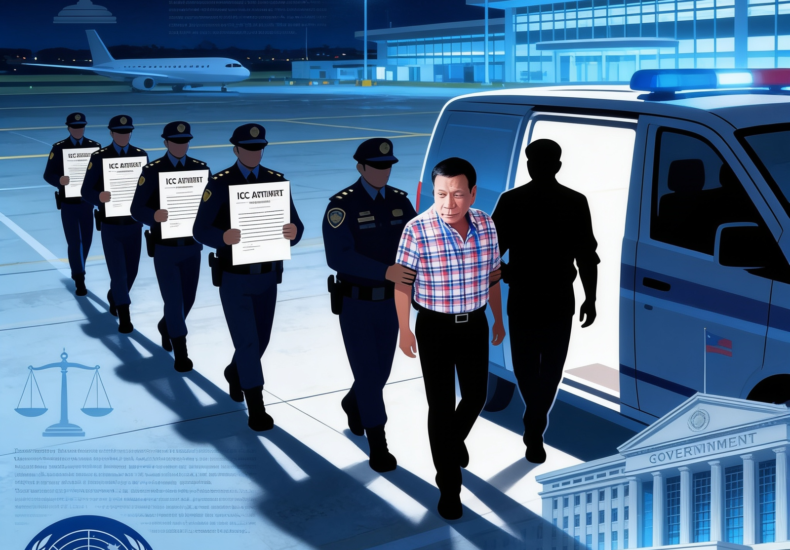
Sovereignty Versus Structural Pressures The Philippine Situation
Sovereignty vs. Structural Pressures: The Philippine Situation
Analytical Studies & Perspectives of Roldan G. Gorgonio
Can the Philippines genuinely claim to pursue an independent foreign policy, as mandated by the Constitution, while cooperating with international institutions that may influence domestic legal and political processes?
Contextual Note
The tension between the constitutional mandate for an independent foreign policy and the realities of global integration remains a central crisis of the Philippine state. Article II, Section 7 of the 1987 Constitution explicitly dictates that the state shall pursue an independent foreign policy, designating national sovereignty, territorial integrity, and the right to self-determination as paramount considerations (Supreme Court of the Philippines, 2021a). Yet, this constitutional ideal is consistently subverted. Instead of functioning as an authentic expression of popular will, the state’s engagement with international legal and defense frameworks operates as a mechanism for elite power consolidation, constitutional evasion, and institutional erosion.
The Sovereignty We Choose
The constitutional mandate for independence does not dictate isolationism. In Tañada v. Angara (1997), the Supreme Court of the Philippines rejected the notion of a “hermit-type isolation,” establishing that sovereignty is not absolute but self-restricting (Supreme Court of the Philippines, 1997). The state voluntarily limits its power in exchange for systemic stability and mutual benefits.
Citing German jurist Georg Jellinek, the Court defined auto-limitation as the exclusive capacity of a state-force for legal self-determination and self-restriction (Supreme Court of the Philippines, 1997). This principle is deeply rooted in Philippine jurisprudence, matching earlier findings in Reagan v. Commissioner of Internal Revenue (1969), which affirmed that a state may submit to restrictions on its sovereign rights without diminishing its core sovereignty.
True independence is not the absence of external relations (Arillo, 2011). It is the state’s capacity to remain the primary, responsible actor in determining its response to internal and external threats (Philippine Information Agency, 2025).
This legal reality aligns with modern international relations theory. Krasner (2009) argues that entering into international agreements is an active execution of international legal sovereignty, not a capitulation. “Shared sovereignty” arrangements demonstrate how national actors can voluntarily compromise “Westphalian” autonomy to enhance domestic sovereignty (Krasner, 2009).
The state retains its core sovereign power, including the formal right to withdraw from agreements (Krasner, 2009). The Supreme Court confirmed this executive authority in Pangilinan v. Cayetano (2021), ruling that the decision to join or withdraw from a treaty is an act of sovereign will (Regalado Bagares, 2023).
Under the transformation and incorporation clauses of the Constitution, treaties function as legislative self-limitations that do not override the Constitution but operate as integrated domestic statutes (UP College of Law, 2021; Supreme Court of the Philippines, 2021a). Within this architecture, global engagement is a strategic necessity to protect national sovereignty and achieve domestic stability (Le, 2015).
The Cleanup Function of International Law
The intersection of international law and domestic accountability is visible in the execution of the International Criminal Court (ICC) arrest warrant for former President Rodrigo Duterte on March 11, 2025 (Human Rights Watch, 2025).
Duterte’s allies argued that executing the warrant violated national sovereignty, citing the country’s 2019 withdrawal from the Rome Statute and the existence of functioning domestic courts (Araneta-Alana, 2025).
The administration of Ferdinand Marcos Jr. executed the warrant by integrating domestic statutes with international frameworks, bypassing local judicial gridlock. The Department of Justice (2025) leveraged the state’s active membership in INTERPOL, treating the Red Notice as a binding request for international police cooperation.
This enforcement was grounded in domestic law. Section 17 of Republic Act No. 9851 (the Philippine Act on Crimes Against International Humanitarian Law, Genocide, and Other Crimes Against Humanity) explicitly permits domestic authorities to dispense with local prosecution and “may” surrender accused individuals to appropriate international courts (Republic Act No. 9851, 2009).
The Philippines utilized international pathways to enforce its own commitment to human rights (Castro, 2026). The arrest of Former President Duterte was a sovereign decision to use international judicial processes to resolve a crisis of domestic accountability (Brookings Institution, 2025).
Although the arrest caused political friction, such as the Senate placing Senator Ronald “Bato” dela Rosa under protective custody in 2026, proponents argue that cooperating with the ICC reinforces the rule of law when domestic systems face structural blockages (Manila Standard, 2026).
International judicial mechanisms serve as vital safeguards against impunity (De Lima, 2026). Rather than a loss of strategic autonomy, this hybridization of domestic law and international cooperation acts as a tool for what we call systemic cleanup, bypassing localized political cartels to enforce accountability.
Law as Leverage
In the West Philippine Sea, international legal institutions serve as essential force multipliers. Facing maritime coercion, the Philippines relies on the 2016 Permanent Court of Arbitration (PCA) ruling issued under the United Nations Convention on the Law of the Sea (UNCLOS) to defend its maritime territory.
The Marcos Jr. administration has framed this approach around a “rules-based international order” (GraSPP, 2023). The regime maintained that it is the best guarantee for the sovereign equality of all states, regardless of size (Marcos, 2024).
Here, the state does not merely conform to external regimes. It actively deploys its agency to shape international norms (Misalucha-Willoughby, 2023). By pursuing international arbitration, the Philippines utilized international law as an equalizer, translating its constitutional mandate to preserve territorial integrity into concrete legal realities. In this context, cooperation with UNCLOS and the PCA is not a capitulation, but, as the Marcos administration claims, an effective instrument for protecting national sovereignty.
Similarly, expanding military agreements with the United States—specifically the Visiting Forces Agreement (VFA) and the Enhanced Defense Cooperation Agreement (EDCA)—demonstrates strategic efficiency. Critics argue that expanding EDCA subordinates domestic defense to US geopolitical interests, risking a loss of strategic autonomy (Raymundo, 2025; IBON Foundation, 2023). This argument ignores the domestic legal verification of these security frameworks. In Saguisag v. Ochoa, Jr. (2016), the Supreme Court upheld EDCA as a constitutional executive agreement, noting that it implements the pre-existing, Senate-ratified Mutual Defense Treaty without creating new military bases (Supreme Court of the Philippines, 2016a).
For the protagonists, alliance-building is a necessary tool of statecraft (Venkataramani, 2023). An independent foreign policy does not mandate absolute neutrality (Philippine Embassy Brasilia). Instead, it compels the state to cooperate with allies on matters of shared interest while maintaining the right to disagree when views differ.
The Executive’s Legal Arsenal
Supporters of state actions often rely on the jurisprudential doctrine of auto-limitation to justify the surrender of domestic authority to international bodies. Under this framework, first articulated locally in Tañada v. Angara (1997) and tracing back to Reagan v. Commissioner of Internal Revenue (1969), the Supreme Court of the Philippines ruled that sovereignty is not absolute.
The state may voluntarily restrict its absolute power through treaties in exchange for mutual global benefits (Supreme Court of the Philippines, 1997). This perspective claims that cooperating with international institutions is a sovereign choice that actually enhances domestic capabilities (Krasner, 2009).
However, this legalistic defense serves as a convenient facade. In practice, the executive branch routinely weaponizes these international alignments to neutralize domestic political competitors and preserve elite control.
This weaponization of international law is acutely visible in the execution of the International Criminal Court (ICC) arrest warrant against former President Rodrigo Duterte on March 11, 2025 (Department of Justice, 2025; Human Rights Watch, 2025). While framed by proponents and human rights advocates as a triumph of international accountability and a remedy for domestic institutional failures (De Lima, 2026; Castro, 2026), the arrest reveals a calculated domestic strategy. The administration of Ferdinand Marcos Jr. utilized the machinery of INTERPOL and Republic Act No. 9851 to execute the warrant, bypassing the traditional arguments of state sovereignty that the executive branch historically defended (Department of Justice, 2025; University of the Philippines College of Law, 2025).
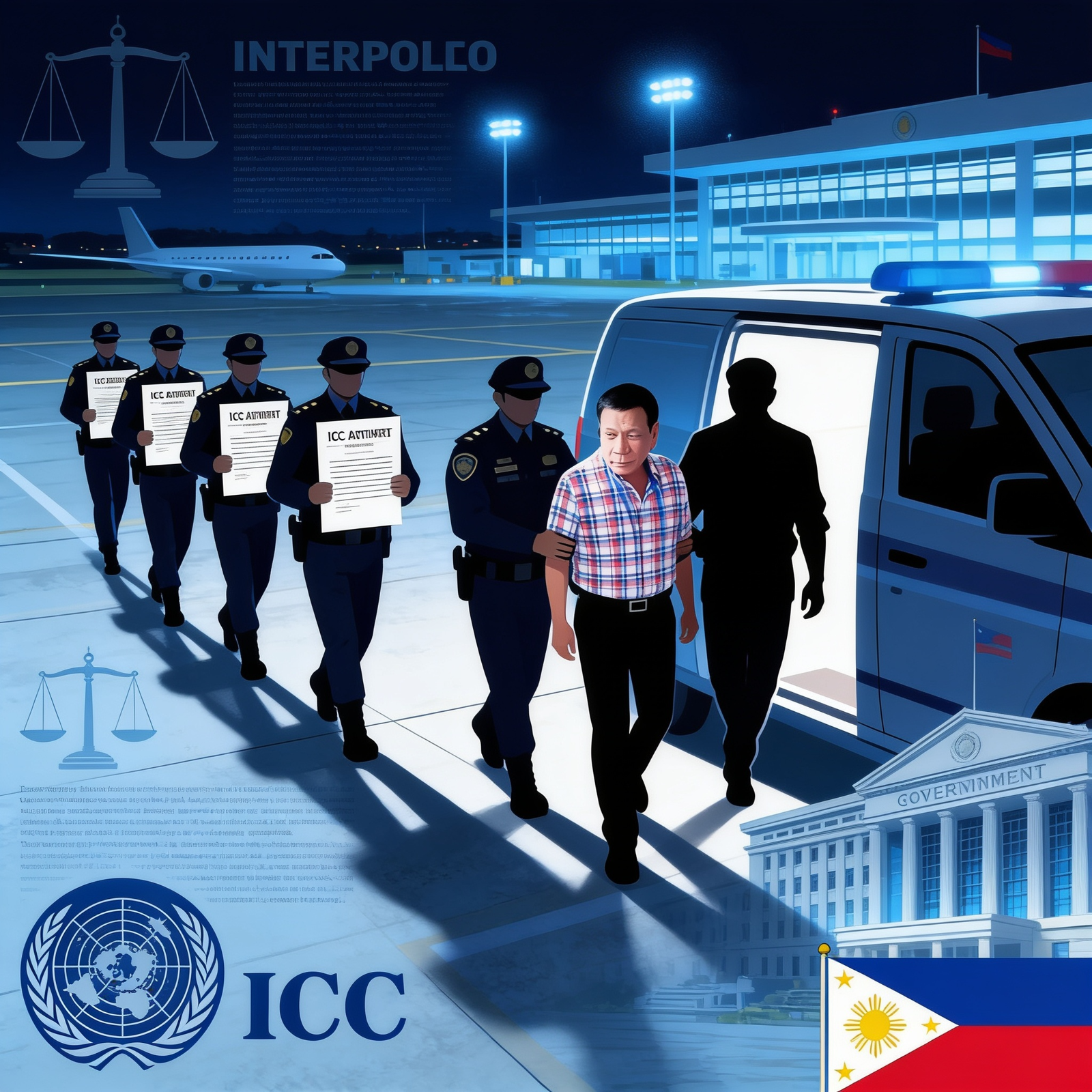
This move was not a neutral application of justice. It was a targeted maneuver to dismantle a competing political faction. By leveraging international judicial mechanisms, the ruling elite successfully neutralized a formidable domestic rival under the guise of global legal compliance. This strategy allowed the administration to consolidate power amid a persistent crisis of political legitimacy (Center for People Empowerment in Governance, 2025).
The fallout from this selective compliance has triggered severe institutional deterioration and democratic erosion. The arrest and subsequent threat of further warrants fractured the state’s internal stability. In 2026, the Senate placed Senator Ronald “Bato” dela Rosa under “protective custody” to shield him from an impending ICC warrant, culminating in high-stakes security standoffs within the legislative building itself (Manila Standard, 2026).
This intra-state standoff illustrates how the instrumentalization of international law paralyzes domestic governance. Rather than reinforcing the rule of law, the selective adoption of international mandates breeds deep institutional friction, exposing the fragility of a state where constitutional processes are subordinated to factional warfare.
This internal instability is exacerbated by the highly fragmented nature of the Philippine political order. Powerful traditions of political personalism and localized clan feuds consistently weaken central authority, ensuring that narrow family interests override national legal processes (White, 2014).
Consequently, foreign policy is never cohesive. It swings erratically based on the personal survival strategies of the sitting president. The dramatic transition from Duterte’s Beijing-leaning posture to Marcos Jr.’s rapid realignment with Washington demonstrates this systemic instability (Gill, 2023). Under this personalized governance model, international legal arguments are adopted or discarded solely to validate the executive’s shifting political alignments.
This susceptibility to external pressure is further evident in the nation’s defense architecture, which critics identify as a form of structural neocolonialism. Historically, the post-1946 Philippine state has functioned as an American neocolony, with its developmental, economic, and security policies structurally subordinated to American geopolitical interests (Tan, 2008; Arillo, 2011). Though the formal 1947 Military Bases Agreement expired in 1991, subsequent defense treaties like the 1999 Visiting Forces Agreement (VFA) and the 2014 Enhanced Defense Cooperation Agreement (EDCA) have functionally restored a pervasive foreign military presence (ICHRP, 2025).
The legal validation of these agreements reveals a systematic erosion of constitutional checks and balances. In Saguisag v. Ochoa (2016), the Supreme Court upheld EDCA as a constitutionally permissible executive agreement, arguing that it merely implemented pre-existing treaties like the Mutual Defense Treaty of 1951 (Supreme Court of the Philippines, 2016a). This ruling allowed the executive branch to bypass the mandatory constitutional requirement for Senate concurrence on new foreign military treaties (Raymundo, 2025).
By utilizing executive agreements to deepen military integration, the state elite insulated their defense policy from legislative scrutiny. This constitutional shortcut effectively surrendered strategic autonomy, transforming the domestic territory into a potential battleground for Sino-American rivalry while ignoring domestic demands for strict non-alignment (IBON Foundation, 2023; Gerale, 2025).
Global Regimes Entrenching Domestic Elite Power
Ultimately, the international legal frameworks and multilateral institutions designed to protect sovereignty are frequently utilized by dominant global powers to justify intervention in domestic affairs (Butterfield, 1966). Contemporary international lawmaking does not guarantee equal representation for nations of the global South (European Commission for Democracy through Law, 2011). Instead, powerful states in the global North and international financial institutions exert intense material and social pressure on developing nations to conform to specific liberal and strategic alignments (Coe, 2019). The Philippine elite routinely capitulates to these external pressures, navigating the international image of the country to preserve personal and class legitimacy rather than pursuing a genuinely independent developmental or defense agenda (Coe, 2019; Le, 2015).
Future scholarly inquiry must address the precise legal and political mechanisms that allow the executive branch to bypass constitutional constraints on sovereignty without facing institutional accountability. Research should also examine the long-term impact of selective international law enforcement on the stability of domestic judicial institutions. The contemporary history of the Philippines demonstrates that as long as foreign policy remains an instrument for elite survival and factional neutralization, the constitutional mandate for an independent foreign policy will remain a legal fiction. True strategic autonomy is structurally impossible when international cooperation is deployed to consolidate domestic autocracy.
References
.Abinales, P. N., & Amoroso, D. J. (2017). State and society in the Philippines. Rowman & Littlefield. [https://books.google.com/books/about/StateandSocietyinthePhilippines.html?id=zRFiEQAAQBAJ](https://books.google.com/books/about/StateandSocietyinthePhilippines.html?id=zRFiEQAAQBAJ&utm_source=copilot.com “books.google.com”)
Amador, J. (2017, April 17). Understanding President Duterte’s “independent foreign policy.” Stratbase ADRi. [https://www.fsi.gov.ph/understanding-president-dutertes-independent-foreign-policy/](https://www.fsi.gov.ph/understanding-president-dutertes-independent-foreign-policy/?utm_source=copilot.com “www.fsi.gov.ph”)
Araneta-Alana, N. (2025, July 21). Duterte’s arrest, the ICC, and the politics of accountability. Opinio Juris. [https://opiniojuris.org/2025/07/21/dutertes-arrest-the-icc-and-the-politics-of-accountability/](https://opiniojuris.org/2025/07/21/dutertes-arrest-the-icc-and-the-politics-of-accountability/?utm_source=copilot.com “opiniojuris.org”)
Ateneo de Manila University. (2008, June 30). American military bases in the Philippines: The Brownell opinion. Archīum Ateneo. [https://archium.ateneo.edu/discussions/1](https://archium.ateneo.edu/discussions/1?utm_source=copilot.com “archium.ateneo.edu”)
Avalon Project. (1951, August 30). Mutual Defense Treaty between the United States and the Republic of the Philippines; August 30, 1951. Yale Law School. [https://avalon.law.yale.edu/20thcentury/phil001.asp](https://avalon.law.yale.edu/20thcentury/phil001.asp?utm_source=copilot.com “avalon.law.yale.edu”)
Barnett, M., & Duvall, R. (2005). Power in global governance (Vol. 98). Cambridge University Press. [https://doi.org/10.1017/CBO9780511491207](https://doi.org/10.1017/CBO9780511491207?utm_source=copilot.com “doi.org”)
Broad, R. (1988). Unequal alliance: The World Bank, the International Monetary Fund and the Philippines. University of California Press. [https://www.ucpress.edu/book/9780520069534/unequal-alliance](https://www.ucpress.edu/book/9780520069534/unequal-alliance?utm_source=copilot.com “www.ucpress.edu”)
Brookings Institution. (2025, April 1). Why did the Philippines turn over its former president to the ICC? Brookings Institution. [https://www.brookings.edu/articles/why-did-the-philippines-turn-over-its-former-president-to-the-icc/](https://www.brookings.edu/articles/why-did-the-philippines-turn-over-its-former-president-to-the-icc/?utm_source=copilot.com “www.brookings.edu”)
Butterfield, H., & Wight, M. (1966). Diplomatic investigations: Essays on the theory of international politics. George Allen & Unwin.
Candelaria, J. L. (2019, September 1). Utilizing soft power in the conduct of foreign policy: Current realities and prospects for the Philippines. UP CIDS. [https://cids.up.edu.ph/utilizing-soft-power-foreign-policy/](https://cids.up.edu.ph/utilizing-soft-power-foreign-policy/?utm_source=copilot.com “cids.up.edu.ph”)
Castro, C. (2026, June 11). Palace: PH need not rejoin ICC to fight impunity. Inquirer.net. [https://globalnation.inquirer.net/239564/palace-ph-need-not-rejoin-icc-to-fight-impunity](https://globalnation.inquirer.net/239564/palace-ph-need-not-rejoin-icc-to-fight-impunity?utm_source=copilot.com “globalnation.inquirer.net”)
Cecilio T. Arillo. (2011). A country imperiled: Tragic lessons of a distorted history. IAME Books. [https://www.goodreads.com/book/show/20428776-a-country-imperiled](https://www.goodreads.com/book/show/20428776-a-country-imperiled?utm_source=copilot.com “www.goodreads.com”)
Center for People Empowerment in Governance. (2025, November 20). Midterm of the Marcos administration: Consolidating power amid crisis of legitimacy. CenPEG. [http://www.cenpeg.org/midterm-marcos-administration](https://www.cenpeg.org/midterm-marcos-administration?utm_source=copilot.com “www.cenpeg.org”)
Center for People Empowerment in Governance (CenPEG). (2025, November 6). Philippine foreign policy under Ferdinand Marcos, Jr. CenPEG. [https://www.cenpeg.org/publications/MarcosForeignPolicyNov2025.pdf](https://www.cenpeg.org/publications/MarcosForeignPolicyNov2025.pdf?utm_source=copilot.com “www.cenpeg.org”)
Center for Strategic and International Studies. (2025, September 4). The uniquely stable U.S.-Philippines partnership. CSIS. [https://www.csis.org/analysis/uniquely-stable-us-philippines-partnership](https://www.csis.org/analysis/uniquely-stable-us-philippines-partnership?utm_source=copilot.com “www.csis.org”)
Cooper, B., Dyzenhaus, D., & Heller, H. (2019). Sovereignty: A contribution to the theory of public and international law. Oxford University Press.
Coe, B. N. (2019). Sovereignty in the South: Intrusive regionalism in Africa, Latin America, and Southeast Asia. Routledge.
Cook, M. (2019, June 13). The Philippines’ alliance problems with the USA. ISEAS–Yusof Ishak Institute. [https://www.iseas.edu.sg/images/pdf/ISEASPerspective201948.pdf](https://www.iseas.edu.sg/images/pdf/ISEASPerspective201948.pdf?utm_source=copilot.com “www.iseas.edu.sg”)
Council on Foreign Relations. (2016). The U.S.-Philippines defense alliance. Council on Foreign Relations. [https://www.cfr.org/backgrounder/us-philippines-defense-alliance](https://www.cfr.org/backgrounder/us-philippines-defense-alliance?utm_source=copilot.com “www.cfr.org”)
CSIS. (2023, February 2). The transformation of the U.S.-Philippines alliance. Center for Strategic and International Studies. [https://www.csis.org/analysis/transformation-us-philippines-alliance](https://www.csis.org/analysis/transformation-us-philippines-alliance?utm_source=copilot.com “www.csis.org”)
De Lima, L. (2026, June 5). De Lima bats for Philippines’ return to ICC. The Manila Times. [https://www.manilatimes.net/2026/06/05/news/national/de-lima-bats-for-philippines-return-to-icc/1944512](https://www.manilatimes.net/2026/06/05/news/national/de-lima-bats-for-philippines-return-to-icc/1944512?utm_source=copilot.com “www.manilatimes.net”)
Department of Justice. (2025, March 11). Press statement on the arrest of Rodrigo Roa Duterte. Department of Justice. [https://www.doj.gov.ph/newshtml/press-statement-on-duterte-arrest](https://www.doj.gov.ph/newshtml/press-statement-on-duterte-arrest?utm_source=copilot.com “www.doj.gov.ph”)
Derian, J. D. (2009). Critical practices in international theory: Selected essays. Routledge. [https://doi.org/10.4324/9780203882634](https://doi.org/10.4324/9780203882634?utm_source=copilot.com “doi.org”)
EJIL: Talk!. (2026, January 20). The ICC’s residual jurisdiction & the situation in the Philippines. EJIL: Talk!. [https://www.ejiltalk.org/the-iccs-residual-jurisdiction-the-situation-in-the-philippines/](https://www.ejiltalk.org/the-iccs-residual-jurisdiction-the-situation-in-the-philippines/?utm_source=copilot.com “www.ejiltalk.org”)
Embassy of the Philippines in Islamabad. (n.d.). About. Embassy of the Republic of the Philippines in Islamabad. [https://islamabadpe.dfa.gov.ph/about](https://islamabadpe.dfa.gov.ph/about?utm_source=copilot.com “islamabadpe.dfa.gov.ph”)
European Commission for Democracy through Law. (2011). Definition and development of human rights and popular sovereignty in Europe. Council of Europe Publishing. [https://book.coe.int/en/constitutional-law/4758-definition-and-development-of-human-rights-and-popular-sovereignty-in-europe-science-and-technique-of-democracy-no-49.html](https://book.coe.int/en/constitutional-law/4758-definition-and-development-of-human-rights-and-popular-sovereignty-in-europe-science-and-technique-of-democracy-no-49.html?utm_source=copilot.com “book.coe.int”)
Gerale, C. P. (2025, December 15). The illusion of strength: The Marcos Jr. foreign policy trap. Medium. [https://medium.com/@christopherpallergerale/the-illusion-of-strength-the-marcos-jr-foreign-policy-trap](https://medium.com/@christopherpallergerale/the-illusion-of-strength-the-marcos-jr-foreign-policy-trap?utm_source=copilot.com “medium.com”)
Gill, D. M. (2023, June 20). Navigating contemporary Philippine foreign policy under Marcos Jr. Observer Research Foundation. [https://www.orfonline.org/research/navigating-contemporary-philippine-foreign-policy-under-marcos-jr/](https://www.orfonline.org/research/navigating-contemporary-philippine-foreign-policy-under-marcos-jr/?utm_source=copilot.com “www.orfonline.org”)
Global News. (2016, September 10). Duterte: Gov’t to pursue “independent foreign policy.” Global News. [https://globalnews.ca/news/2932822/duterte-govt-to-pursue-independent-foreign-policy/](https://globalnews.ca/news/2932822/duterte-govt-to-pursue-independent-foreign-policy/?utm_source=copilot.com “globalnews.ca”)
GraSPP. (2023, November 16). Between the eagle and the dragon: What is the Philippines’ foreign policy? University of Tokyo. [https://www.graspp.u-tokyo.ac.jp/en/news/2023-11-16-philippines-foreign-policy/](https://www.graspp.u-tokyo.ac.jp/en/news/2023-11-16-philippines-foreign-policy/?utm_source=copilot.com “www.graspp.u-tokyo.ac.jp”)
Heritage Foundation. (1984, April 20). The key role of U.S. bases in the Philippines. The Heritage Foundation. [https://www.heritage.org/asia/report/the-key-role-us-bases-the-philippines](https://www.heritage.org/asia/report/the-key-role-us-bases-the-philippines?utm_source=copilot.com “www.heritage.org”)
Human Rights Watch. (2025, March 11). Philippines: Duterte arrested on ICC warrant. Human Rights Watch. [https://www.hrw.org/news/2025/03/11/philippines-duterte-arrested-icc-warrant](https://www.hrw.org/news/2025/03/11/philippines-duterte-arrested-icc-warrant?utm_source=copilot.com “www.hrw.org”)
IBON Foundation. (2023, June 12). A continuing quest for freedom. IBON Foundation. [https://www.ibon.org/a-continuing-quest-for-freedom/](https://www.ibon.org/a-continuing-quest-for-freedom/?utm_source=copilot.com “www.ibon.org”)
IMF. (2020, February 6). Philippines: 2019 Article IV consultation. International Monetary Fund. [https://www.imf.org/en/Publications/CR/Issues/2020/02/06/Philippines-2019-Article-IV-Consultation-Press-Release-and-Staff-Report-49021](https://www.imf.org/en/Publications/CR/Issues/2020/02/06/Philippines-2019-Article-IV-Consultation-Press-Release-and-Staff-Report-49021?utm_source=copilot.com “www.imf.org”)
Inquirer. (2014, May 27). EDCA challenged in Supreme Court. Global Nation. [https://globalnation.inquirer.net/105151/edca-challenged-in-supreme-court](https://globalnation.inquirer.net/105151/edca-challenged-in-supreme-court?utm_source=copilot.com “globalnation.inquirer.net”)
Inquirer. (2016, September 11). Duterte: Gov’t to pursue “independent foreign policy.” Philippine Daily Inquirer. [https://globalnation.inquirer.net/144565/duterte-im-no-fan-of-us](https://globalnation.inquirer.net/144565/duterte-im-no-fan-of-us?utm_source=copilot.com “globalnation.inquirer.net”)
Inquirer. (2026, June 4). Sovereignty or shield? ICC appeal grows as powerful convicts can be freed at home. Philippine Daily Inquirer. [https://newsinfo.inquirer.net/1923483/sovereignty-or-shield-icc-appeal-grows](https://newsinfo.inquirer.net/1923483/sovereignty-or-shield-icc-appeal-grows?utm_source=copilot.com “newsinfo.inquirer.net”)
Inquirer.net. (2016, September 10). Duterte: Gov’t to pursue “independent foreign policy.” Inquirer.net. [https://globalnation.inquirer.net/144498/duterte-govt-to-pursue-independent-foreign-policy](https://globalnation.inquirer.net/144498/duterte-govt-to-pursue-independent-foreign-policy?utm_source=copilot.com “globalnation.inquirer.net”)
Inquirer.net. (2024, November 13). Palace: Duterte free to surrender to ICC if he wishes. Inquirer.net. [https://newsinfo.inquirer.net/1972551/palace-duterte-free-to-surrender-to-icc](https://newsinfo.inquirer.net/1972551/palace-duterte-free-to-surrender-to-icc?utm_source=copilot.com “newsinfo.inquirer.net”)
International Coalition for Human Rights in the Philippines. (2025, September 16). US military out of the Philippines! Stand with the people against foreign plunder and domination! ICHRP. [https://ichrp.net/us-military-out-of-the-philippines/](https://ichrp.net/us-military-out-of-the-philippines/?utm_source=copilot.com “ichrp.net”)
ISEAS–Yusof Ishak Institute. (2021, December 10). Mind the gaps, fill the needs: A strategic outlook for the Philippine–US alliance. ISEAS. [https://www.iseas.edu.sg/articles-commentaries/iseas-perspective/2021-152/](https://www.iseas.edu.sg/articles-commentaries/iseas-perspective/2021-152/?utm_source=copilot.com “www.iseas.edu.sg”)
Kung, C.-W. (2022, November 1). Diasporic cold warriors: Nationalist China, anticommunism, and the Philippine Chinese, 1930s–1970s. Pacific Affairs. [https://pacificaffairs.ubc.ca/book-reviews/diasporic-cold-warriors-nationalist-china-anticommunism-and-the-philippine-chinese-1930s-1970s-by-chien-wen-kung/](https://pacificaffairs.ubc.ca/book-reviews/diasporic-cold-warriors-nationalist-china-anticommunism-and-the-philippine-chinese-1930s-1970s-by-chien-wen-kung/?utm_source=copilot.com “pacificaffairs.ubc.ca”)
LawPhil. (n.d.). 1987 Philippine Constitution. The LawPhil Project. [https://lawphil.net/consti/cons1987.html](https://lawphil.net/consti/cons1987.html?utm_source=copilot.com “lawphil.net”)
Le, H. (2015). The art of consulting. Self-published. [https://www.goodreads.com/book/show/25185126-the-art-of-consulting](https://www.goodreads.com/book/show/25185126-the-art-of-consulting?utm_source=copilot.com “www.goodreads.com”)
Lichauco, A. (1973, January 1). American neocolonialism in the Philippines. Monthly Review Press. [https://monthlyreview.org/product/americanneocolonialisminthephilippines/](https://monthlyreview.org/product/americanneocolonialisminthephilippines/?utm_source=copilot.com “monthlyreview.org”)
Loja, M., & Bagares, R. R. (2024, May 16). Nothing-burger? U.S. obligation to defend the Philippines in the South China Sea – Part 1. EJIL: Talk!. [https://www.ejiltalk.org/nothing-burger-u-s-obligation-to-defend-the-philippines-part-1/](https://www.ejiltalk.org/nothing-burger-u-s-obligation-to-defend-the-philippines-part-1/?utm_source=copilot.com “www.ejiltalk.org”)
Lowy Institute. (2022, May 13). What a Marcos Jr presidency in the Philippines means for geopolitics. Lowy Institute. [https://www.lowyinstitute.org/the-interpreter/what-marcos-jr-presidency-philippines-means-geopolitics](https://www.lowyinstitute.org/the-interpreter/what-marcos-jr-presidency-philippines-means-geopolitics?utm_source=copilot.com “www.lowyinstitute.org”)
Manila Bulletin. (2026, May 29). The International Criminal Court and Philippine sovereignty. Manila Bulletin. [https://mb.com.ph/2026/05/29/the-international-criminal-court-and-philippine-sovereignty](https://mb.com.ph/2026/05/29/the-international-criminal-court-and-philippine-sovereignty?utm_source=copilot.com “mb.com.ph”)
Manila Standard. (2026, June 8). The Senate drama: Back to the core issues. Manila Standard. [https://manilastandard.net/opinion/314467/the-senate-drama-back-to-the-core-issues](https://manilastandard.net/opinion/314467/the-senate-drama-back-to-the-core-issues?utm_source=copilot.com “manilastandard.net”)
Marcos, F. E. (1974). The democratic revolution in the Philippines. Prentice-Hall International. [https://openlibrary.org/works/OL2611857W](https://openlibrary.org/works/OL2611857W?utm_source=copilot.com “openlibrary.org”)
Marcos, F. R., Jr. (2024, March 4). Keynote speech at the Lowy Institute. Lowy Institute. [https://www.lowyinstitute.org/publications/keynote-speech-president-ferdinand-r-marcos-jr-lowy-institute](https://www.lowyinstitute.org/publications/keynote-speech-president-ferdinand-r-marcos-jr-lowy-institute?utm_source=copilot.com “www.lowyinstitute.org”)
McCoy, A. W., & de Jesus, E. C. (1982). Philippine social history: Global trade and local transformations (Vol. 45). Ateneo de Manila University Press. [https://doi.org/10.2307/2056590](https://doi.org/10.2307/2056590?utm_source=copilot.com “doi.org”)
Misalucha-Willoughby, C. (2023, July 3). The Philippines and the liberal rules-based international order. Oxford Academic. [https://academic.oup.com/ia/article/99/4/1537/7212456](https://academic.oup.com/ia/article/99/4/1537/7212456?utm_source=copilot.com “academic.oup.com”)
Nadeau, K. M. (2002). Liberation theology in the Philippines: Faith in a revolution. Praeger Publishers. [https://books.google.com/books/about/LiberationTheologyinthePhilippines.html?id=kAINJWo4IJ4C](https://books.google.com/books/about/LiberationTheologyinthePhilippines.html?id=kAINJWo4IJ4C&utm_source=copilot.com “books.google.com”)
Office of the Historian. (n.d.). Foreign Relations of the United States, 1955–1957, Southeast Asia, Volume XXII. U.S. Department of State. [https://history.state.gov/historicaldocuments/frus1955-57v22/d299](https://history.state.gov/historicaldocuments/frus1955-57v22/d299?utm_source=copilot.com “history.state.gov”)
OHCHR. (2022, September 14). Human rights Philippines. Office of the UN High Commissioner for Human Rights. [https://www.ohchr.org/en/documents/country-reports/human-rights-philippines-joint-program](https://www.ohchr.org/en/documents/country-reports/human-rights-philippines-joint-program?utm_source=copilot.com “www.ohchr.org”)
Opinio Juris. (2018, October 18). Withdrawal from the International Criminal Court: “Much ado about nothing” at the Philippine Supreme Court? (Part I). Opinio Juris. [https://opiniojuris.org/2018/10/18/withdrawal-from-the-international-criminal-court-much-ado-about-nothing-at-the-philippine-supreme-court-part-i/](https://opiniojuris.org/2018/10/18/withdrawal-from-the-international-criminal-court-much-ado-about-nothing-at-the-philippine-supreme-court-part-i/?utm_source=copilot.com “opiniojuris.org”)
Philippine Embassy Brasilia. (n.d.). Philippine foreign policy. Embassy of the Philippines in Brazil. [http://philembassybrasilia.org/philippine-foreign-policy/](https://philembassybrasilia.org/philippine-foreign-policy/?utm_source=copilot.com “philembassybrasilia.org”)
Philippine Embassy in Brazil. (n.d.). Philippine foreign policy. Embassy of the Philippines in Brasilia. [http://philembassybrasilia.org/portal/index.php/philippine-foreign-policy](https://philembassybrasilia.org/portal/index.php/philippine-foreign-policy?utm_source=copilot.com “philembassybrasilia.org”)
Philippine Information Agency. (2025, June 19). Towards an independent foreign policy. Philippine Information Agency. [https://pia.gov.ph/features/towards-an-independent-foreign-policy](https://pia.gov.ph/features/towards-an-independent-foreign-policy?utm_source=copilot.com “pia.gov.ph”)
Raymundo, S. (2025, September 7). Twin pillars of neo-colonialism: Land lease and military bases under Marcos Jr. Bulatlat. [https://www.bulatlat.com/2025/09/07/twin-pillars-of-neo-colonialism/](https://www.bulatlat.com/2025/09/07/twin-pillars-of-neo-colonialism/?utm_source=copilot.com “www.bulatlat.com”)
Regalado Bagares, R. (2023, April 17). The “things said in passing”: The Duterte drug war, presidential foreign policy prerogatives, and the Rome Statute in Pangilinan v. Cayetano. Cambridge University Press. [https://www.cambridge.org/core/journals/asian-journal-of-international-law/article/things-said-in-passing-the-duterte-drug-war-philippine-presidential-foreign-policy-prerogatives-and-the-rome-statute-of-the-international-criminal-court-in-pangilinan-v-cayetano/7C21AA7D93B4EABBD8353A17130F6C92](https://www.cambridge.org/core/journals/asian-journal-of-international-law/article/things-said-in-passing-the-duterte-drug-war-philippine-presidential-foreign-policy-prerogatives-and-the-rome-statute-of-the-international-criminal-court-in-pangilinan-v-cayetano/7C21AA7D93B4EABBD8353A17130F6C92?utm_source=copilot.com “www.cambridge.org”)
Republic Act No. 9851. (2009, December 11). Philippine Act on Crimes Against International Humanitarian Law, Genocide, and Other Crimes Against Humanity. The LawPhil Project. [https://lawphil.net/statutes/repacts/ra2009/ra98512009.html](https://lawphil.net/statutes/repacts/ra2009/ra98512009.html?utm_source=copilot.com “lawphil.net”)
Shalom, S. R. (1981). The United States and the Philippines: A study of neocolonialism (Vol. 76). Institute for the Study of Human Issues. [https://doi.org/10.2307/1963043](https://doi.org/10.2307/1963043?utm_source=copilot.com “doi.org”)
Supreme Court E-Library. (1986, October 15). Article II – Declaration of principles and state policies. Supreme Court of the Philippines. [https://elibrary.judiciary.gov.ph/thebookshelf/showdocs/2/11562](https://elibrary.judiciary.gov.ph/thebookshelf/showdocs/2/11562?utm_source=copilot.com “elibrary.judiciary.gov.ph”)
Supreme Court of the Philippines. (1969, September 30). Reagan v. Commissioner of Internal Revenue, G.R. No. L-26379. [https://lawphil.net/judjuris/juri1969/sep1969/grl-263791969.html](https://lawphil.net/judjuris/juri1969/sep1969/grl-263791969.html?utm_source=copilot.com “lawphil.net”)
Supreme Court of the Philippines. (1997, May 2 & May 8). Tañada v. Angara, G.R. No. 118295. [https://elibrary.judiciary.gov.ph/thebookshelf/showdocs/1/34215](https://elibrary.judiciary.gov.ph/thebookshelf/showdocs/1/34215?utm_source=copilot.com “elibrary.judiciary.gov.ph”)
Supreme Court of the Philippines. (2016, January 12). Saguisag v. Ochoa, Jr., G.R. No. 212426. [https://elibrary.judiciary.gov.ph/thebookshelf/showdocs/1/61622](https://elibrary.judiciary.gov.ph/thebookshelf/showdocs/1/61622?utm_source=copilot.com “elibrary.judiciary.gov.ph”)
Supreme Court of the Philippines. (2016, July 26). Saguisag v. Ochoa (Resolution on Motion for Reconsideration). Lawyerly. [https://lawyerly.ph/juris/view/r1234](https://lawyerly.ph/juris/view/r1234?utm_source=copilot.com “lawyerly.ph”)
Supreme Court of the Philippines. (2021, March 16). Pangilinan v. Cayetano, G.R. No. 238875. [https://lawphil.net/judjuris/juri2021/mar2021/gr2388752021.html](https://lawphil.net/judjuris/juri2021/mar2021/gr2388752021.html?utm_source=copilot.com “lawphil.net”)
You may be interested
How Did Pledges Become a Reality
Assessing the President's Trip : From Pledges to Reality Analytical...
The Weaponization of Laws in Philippine Politics
The Weaponization of Laws in Philippine Politics Analytical Studies &...
The Politics of Impeachment
Analytical Studies & Perspectives of Roldan G. Gorgonio What happens...
Leave a Reply